
A gap in your smile affects more than appearance. The Trimble Dental team designs and places natural-looking dental bridges entirely in-house at Trimble Dental in Menomonie.
A dental bridge is a fixed restoration that replaces one or more missing teeth by anchoring a custom-crafted replacement tooth between two support structures on either side of the gap. Traditional bridges use crowns placed on the natural teeth adjacent to the gap. Implant-supported bridges use dental implants as anchors instead, preserving the surrounding teeth entirely.
In both cases, the bridge is permanently cemented in place and functions just like natural teeth.
At Trimble Dental, the team designs and places every bridge in-house, from the initial impressions to the final cementation, without sending patients to an outside provider at any stage.

Benefit 1: Restoring Function Immediately
A bridge allows you to chew, speak, and smile normally again. Patients often notice the difference in everyday function right away, from easier eating to restored confidence in their smile.
Benefit 2: Preventing Shifting Teeth
When a gap is left unfilled, the neighboring teeth begin to drift toward the space over time. A bridge holds everything in proper alignment and prevents the bite problems and bone loss that drifting teeth can cause.
Benefit 3: A Natural Appearance
The Trimble Dental team designs every bridge to match the color, shape, and size of the surrounding teeth precisely. The finished restoration is indistinguishable from the teeth on either side.
Benefit 4: A Fixed, Permanent Solution
Unlike partial dentures, a bridge is cemented permanently in place. There are no appliances to remove, no adhesives to manage, and no adjustment period.
Benefit 5: Completed Entirely In-House
Every bridge at Trimble Dental is designed, placed, and followed up by the Trimble Dental team, with no referrals and no outside lab visits required of the patient.
Step 1: Consultation and Evaluation
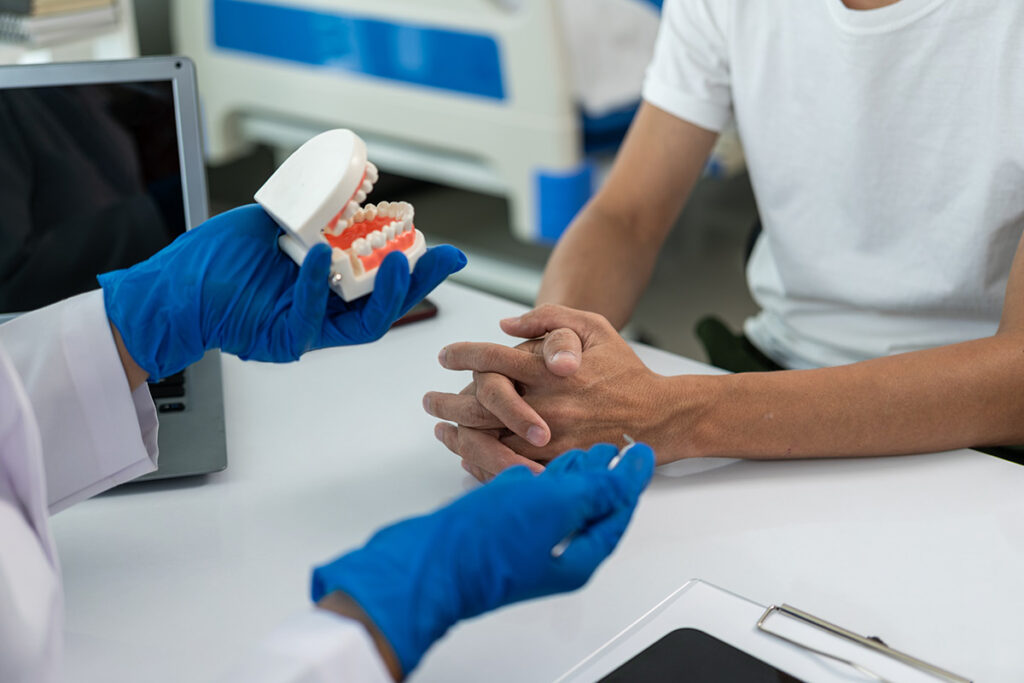
The Trimble Dental team in Menomonie examines the gap, evaluates the adjacent teeth and bone health, and determines whether a traditional or implant-supported bridge is the most appropriate option for your specific situation.
Step 2: Tooth Preparation
For a traditional bridge, the Trimble Dental team carefully prepares the neighboring teeth to receive crowns by removing a precise amount of enamel. For an implant-supported bridge, this step is replaced with implant placement.
Step 3: Impressions and Fabrication
Detailed impressions of your prepared teeth and the gap are taken and sent to a dental lab where your custom bridge is fabricated to match your surrounding teeth in color, shape, and size.
Step 4: Temporary Bridge
While your permanent bridge is being fabricated, the Trimble Dental team places a temporary bridge to protect the prepared teeth and maintain your appearance and function.
Step 5: Final Placement
When your permanent bridge is ready, the Trimble Dental team removes the temporary, verifies the fit and appearance, and cements the final bridge in place.
Step 6: Follow-Up and Care
The Trimble Dental team reviews how to clean around and under your bridge and schedules a follow-up to confirm the fit and bite are correct.
Trimble Dental has served the Menomonie area for over 60 years. Here’s what our patients say about their experience.
The Trimble Dental team is happy to walk you through whether a bridge or an implant is the better option for your specific situation.
A well-maintained dental bridge typically lasts 10 to 15 years or longer. Longevity depends on oral hygiene habits, bite forces, and how consistently patients attend follow-up appointments at Trimble Dental. The Trimble Dental team will show you exactly how to care for your bridge to maximize its lifespan.
It depends on your bone health, the condition of the adjacent teeth, and your personal goals. Implants are generally the gold standard because they preserve bone and do not require altering neighboring teeth. Bridges are an excellent option when implants are not feasible. The Trimble Dental team will walk you through both options clearly.
The procedure is performed under local anesthesia, and sedation is available for patients who want additional comfort. Most patients find the procedure more manageable than they expected. Mild sensitivity in the days following preparation is normal and temporary.
Dental bridges are considered restorative care and are often partially covered by insurance. Coverage varies by plan and the reason for tooth loss. The Trimble Dental team will verify your benefits before your appointment so you know what to expect financially.